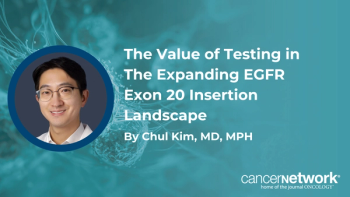
Clinicians must think a lot about how to make testing and novel treatment advances available for patients globally, according to Chul Kim, MD, MPH.
The randomized KANDLELIT-007 trial will enroll approximately 675 patients with advanced non–small cell lung cancer across the world.
Investigators have launched the phase 3 KANDLELIT-007 trial (NCT07190248) evaluating calderasib (MK-1084) plus subcutaneous pembrolizumab and berahyaluronidase alfa-pmph (Keytruda Qlex) as frontline treatment for patients with advanced or metastatic nonsquamous non–small cell lung cancer (NSCLC) harboring KRAS G12C mutations, according to a news release from the developer, Merck.1
As part of the unblinded, open-label, multicenter trial, approximately 675 patients will be assigned to receive calderasib given orally once daily plus subcutaneous pembrolizumab or subcutaneous pembrolizumab in combination with intravenous pemetrexed and chemotherapy. All patients will receive subcutaneous pembrolizumab once every 3 weeks. Those in the comparator arm will receive pemetrexed on days 1 and 22 of each 3-week cycle plus carboplatin or cisplatin on days 1 and 22 for a maximum of 2 cycles.
The trial’s primary end point will be progression-free survival (PFS) among patients with a PD-L1 tumor proportion score of at least 1%. Secondary end points include PFS among all patients, overall survival, overall response rate (ORR), duration of response, and safety.
“While outcomes for patients with NSCLC have significantly improved over the last decade, we know there is more work to do. KRAS is the most frequently mutated oncogene in cancer, and the KRAS G12C mutation occurs in approximately 4% to 14% of all patients with lung cancer globally,” Gregory Lubiniecki, MD, vice president of global clinical development at Merck Research Laboratories, stated in the news release.1 “By pairing our oral calderasib candidate with subcutaneously administered [pembrolizumab] in this trial, we will evaluate whether this chemotherapy-free combination that requires no intravenous access may help improve outcomes for patients with KRAS G12C–mutant NSCLC.”
Developers designed calderasib as a potent and specific KRAS G12C covalent inhibitor. The news release noted that developing small molecule inhibitors directed toward KRAS mutations has been “challenging” despite decades of research on therapeutically targeting this marker.
Patients 18 years and older with nonsquamous stage IIIB or IIIC NSCLC not eligible for curative resection or chemoradiation or those with stage IV disease are eligible for enrollment on the KANDLELIT-007 trial.2 If patients have HIV-positive status, they must have well-controlled disease on antiretroviral therapy to be eligible for enrollment.
Those with small cell lung cancer, active inflammatory bowel disease requiring immunosuppressive medication, significant cardiovascular disease or cerebrovascular disease, or a gastrointestinal disorder impacting absorption are ineligible for study entry. Patients are also unable to enroll on the study if they have received prior systemic anticancer therapy for advanced or metastatic NSCLC, known active central nervous system metastases and/or carcinomatous meningitis, or active autoimmune disease requiring systemic treatment within 2 years of entering the study.
Assessment of calderasib is currently underway in several other clinical trials, including the phase 1 KANDLELIT-001 trial (NCT05067283), which is evaluating the agent’s safety, tolerability, pharmacokinetics, and efficacy among patients with KRAS G12C–mutated advanced solid tumors. Investigators previously presented data from the KANDLELIT-001 trial at the
Data from KANDLELIT-001 revealed an ORR of 38% among patients with colorectal cancer, 38% among those with NSCLC, and 34% among those with other types of solid tumors. In each respective population, the median PFS was 6.2 months (95% CI, 5.1-8.1), 8.3 months (95% CI, 4.2-not reached), and 5.7 months (95% CI, 4.0-14.4). Overall, findings supported the conclusion that calderasib demonstrated manageable safety and promising activity in a range of KRAS G12C–mutated solid tumors.