



Bladder Cancer
Latest News

FDA Grants Fast Track Designation to BT8009 for Advanced/Metastatic Urothelial Cancer
By Russ Conroy
Advertisement
Latest Videos



























































Advertisement
More News

Long-term follow-up showed that the use of pembrolizumab monotherapy maintained durable complete responses, while rates of upstaging at the time of radical cystectomy were consistent with previous findings in the KEYNOTE-057 trial in patients with a bladder cancer subset.

Findings from an interim analysis of data show that the addition of blue light cystoscopy to conventional white light significantly improved clinical outcomes in a group of patients with non–muscle-invasive bladder cancer.

Patients with cisplatin-ineligible muscle-invasive bladder cancer experienced a better rate of downstaging and improved survival benefit with neoadjuvant pembrolizumab prior to radical cystectomy vs immediate radical cystectomy.

With the increasing clinical use of circulating tumor DNA biomarker testing among community urologists, an expert from Tisch Cancer Institute at Mount Sinai in New York City suggests that more prospective data are needed to make the best decisions among patients with bladder cancer.
Atezolizumab is no longer available to treat patients with advanced or metastatic bladder cancer following the manufacturer’s decision to withdraw its U.S. indication after consulting with the FDA.
Rogaratinib showed similar efficacy and manageable safety compared with chemotherapy in the management of FGFR1/3 mRNA–positive locally advanced or metastatic urothelial carcinoma.

A brief review of both neoadjuvant and adjuvant treatment options available to patients with localized bladder cancer.
Opening their discussion on urothelial carcinoma management, panelists highlight risk factors, symptoms, and staging practices in this setting.
Findings from Cohort K of the EV-103 trial demonstrated a 64.5% overall response rate with enfortumab vedotin plus pembrolizumab in metastatic urothelial cancer.
At ESMO 2022, peripheral blood samples taken from patients with advanced or metastatic urothelial carcinoma treated on the phase 3 JAVELIN Bladder 100 trial showed there may be a potential to predict disease response to avelumab.
Shilpa Gupta, MD, and Vinit Makkar, MD, discuss the treatment patterns and disease management of locally advanced/metastatic urothelial carcinoma, with a focus on data from the US physician-based PARADIGM study.

Patients with Bacillus Calmette-Guérin–unresponsive non-muscle invasive bladder carcinoma in situ appear to benefit from treatment with N-803, leading to the FDA accepting its biologics license application.
Results from cohort K of the phase 1b/2 KEYNOTE-869 trial showed improved responses for patients with advanced or metastatic urothelial carcinoma when treated with enfortumab vedotin-efjv plus pembrolizumab.
Roger Li, MD, spoke about future trials planned for the combination of CG0070 plus pembrolizumab for patients with non–muscle invasive bladder cancer who were unresponsive to bacillus Calmette-Guerin.
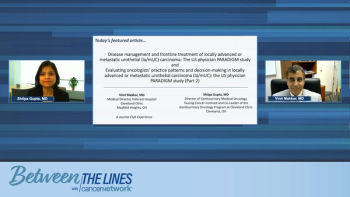
Drs Gupta and Makkar conclude their discussion by highlighting key takeaways from the PARADIGM study and future directions that may address unmet needs in the field of la/mUC.
A look at the key factors associated with 1L and 1LM therapy prescription frequency in the PARADIGM study.
Drs Gupta and Makkar discuss results from the PARADIGM cross-sectional survey, which reveals physicians’ 1L and 1LM treatment patterns in la/mUC.
Experts discuss results from the targeted literature search and qualitative interviews, which identify important factors that impact their treatment decisions for patients with locally advanced/metastatic urothelial carcinoma.
Shilpa Gupta, MD, describes the scope and methods of the PARADIGM study, which examines recent systemic anti-cancer treatment patterns in la/mUC.
Vinit Makkar, MD, provides a brief overview of locally advanced/metastatic urothelial carcinoma (la/mUC), available first-line (1L) and first-line maintenance (1LM) treatment options, and unmet needs in the field.

Belzupacap sarotalocan received fast track designation from the FDA for and will be assessed in a phase 1 clinical trial of patients with non–muscle invasive bladder cancer.
Roger Li, MD, spoke about the safety profile of CG0070 plus pembrolizumab for patients with non–muscle invasive bladder cancer.
Roger Li, MD, spoke about responses from the CORE1 trial that examined patients with non–muscle invasive bladder cancer treated with CG0070 plus pembrolizumab.
Roger Li, MD, spoke about the mechanism of action of CG0070 used in combination with pembrolizumab to treat patients with non–muscle invasive bladder cancer who were unresponsive to bacillus Calmette-Guerin.

Expert panelists focus on the treatment of metastatic urothelial cancer and discuss strategies and challenges for maintenance therapy.
Advertisement
Advertisement
Trending on CancerNetwork
1
Intismeran Plus Pembrolizumab Reduces Recurrence Risk in Resected Melanoma
2
FDA Approves Pembrolizumab in Metastatic TMB-H Solid Tumors
3
What Pope Leo XIV’s Lung Cancer Diagnosis Could Mean for Stigma & Nihilism
4
Zipalertinib May Introduce Another Option to EGFR Exon 20+ NSCLC
5