




Bladder Cancer
Latest News
Advertisement
Video Series

Latest Videos







Shorts

1:02
Optimizing Treatment Tolerance During Intravesical Therapy for Bladder Cancer
2 months ago
by
Goutham Vemana, MD

1:21
How Are BCG Shortages Reshaping Early-Stage Bladder Cancer Workflows?
2 months ago
by
Goutham Vemana, MD

0:51
A “Controversial Take” on ctDNA Monitoring in Advanced Bladder Cancer
3 months ago
by
Mamta Parikh, MD, MS

1:11
More Data Needed To Validate ctDNA Monitoring in Bladder Cancer Care
3 months ago
by
Mamta Parikh, MD, MS

1:28
Where Does ctDNA Testing Fit Into the Recurrent MIBC Landscape?
3 months ago
by
Kirollos S. Hanna, PharmD, BCPS, BCOP, FACCC

1:30
Who Should Receive Adjuvant Immunotherapy After a Radical Cystectomy?
3 months ago
by
Kirollos S. Hanna, PharmD, BCPS, BCOP, FACCC

1:01
Patient Values Inform Treatment Decision-Making in Urothelial Carcinoma
4 months ago
by
Eric Miller, MD

0:38
Detecting Specific CD44 Types in Bladder Cancer With CAR Macrophage Therapy
5 months ago
by
Hiba Siddiqui, BSc

1:17
Highlighting Bladder Preservation Among Vulnerable MIBC Populations
6 months ago
by
Alexander Z. Wei, MD

1:21
Affirming Enfortumab Vedotin/Pembrolizumab as a Standard Across MIBC Groups
7 months ago
by
Joaquim Bellmunt, MD, PhD
Podcasts


























































Advertisement
More News

Data from the phase 2/3 QUILT-3.032 trial support the expanded indication for nogapendekin alfa in BCG-unresponsive non-muscle invasive bladder cancer.

The FDA granted priority review to perioperative durvalumab plus enfortumab vedotin for cisplatin-ineligible muscle-invasive disease, based on phase 3 VOLGA data.
A positive CHMP opinion supports the perioperative use of pembrolizumab plus enfortumab vedotin in resectable MIBC regardless of cisplatin eligibility.

ASTRO’s first standalone clinical practice guideline for bladder cancer recommends trimodal therapy vs radical cystectomy for select muscle-invasive disease cases.
Initial phase 2 SURF302 data show a 79% ORR with 60 mg once-daily oral dabogratinib in FGFR3-altered low-grade intermediate-risk NMIBC.
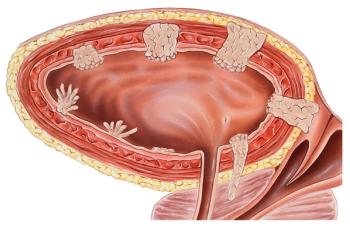
In a real-world setting, enfortumab vedotin plus pembrolizumab produced a 50.2% ORR among patients with metastatic/locally advanced urothelial carcinoma.

Allegheny Health Network Department of Urology is offering a gemcitabine intravesical system to provide the therapy for BCG-unresponsive NMIBC.
Two bladder cancer specialists discussed how emerging ctDNA MRD testing advances will impact treatment selection for patients with MIBC.
A phase 2/3 trial will evaluate enfortumab vedotin plus either ivonescimab or pembrolizumab as frontline therapy for locally advanced/metastatic bladder cancer.

The ctDNA testing guidance in the updated NCCN guidelines were narrowly defined by the IMvigor011 trial population, according to Mamta Parikh, MD, MS.
The UAE granted marketing authorization for nogapendekin alfa plus BCG in BCG-unresponsive NMIBC and with checkpoint inhibitors in metastatic NSCLC.
Final phase 3 BOND-003 Cohort C results showed a 75.5% complete response rate with cretostimogene grenadenorepvec in BCG-unresponsive NMIBC.

Adjuvant atezolizumab nearly doubled disease-free survival in patients with ctDNA-positive muscle-invasive bladder cancer in the phase 3 IMvigor011 trial.
Findings from the phase 3 KEYNOTE-B15/EV-304 trial support the approval of pembrolizumab-based treatment in this bladder cancer population.
A phase 1 study evaluating the safety, tolerability, and feasibility of intravesical UGN-501 is expected to begin in the fourth quarter of 2026.
The tentative approval covers enzalutamide tablets in 4 doses—40 mg, 80 mg, 120 mg, and 160 mg—as a generic equivalent to the reference product.
Findings from the phase 3 EV-303 trial evaluating the enfortumab-based regimen vs surgery alone in this MIBC group supported the regulatory decision.
An informed multiplex PCR circulating tumor DNA–based molecular residual disease test could inform adjuvant treatment following cystectomy.

New ASCO 2026 data reinforced the importance of multidisciplinary coordination and patient-centered decision-making when considering cystectomy omission.
The safety of the IMvigor011 regimen among patients with MIBC was consistent with the established profile of atezolizumab monotherapy.
Updated EV-302 data show EV plus pembrolizumab maintained superior OS and doubled CR rates over chemotherapy in first-line urothelial carcinoma.
Data from the phase 3 POTOMAC trial supported the FDA approval of durvalumab plus BCG in this non-muscle invasive bladder cancer population.
Event-free survival, overall survival, and pathologic complete rate data from the phase 3 KEYNOTE-905 trial support the agency’s decision.
The agency set a Prescription Drug User Fee Act target action date for January 6, 2027, for patients with NMIBC with papillary tumors without CIS.
The investigational BCG-containing regimen conferred a weighted anytime CR rate of 69.7% vs 53.4% with nadofaragene firadenovec in this NMIBC group.
Advertisement
Advertisement
Trending on CancerNetwork
1
Intismeran Plus Pembrolizumab Reduces Recurrence Risk in Resected Melanoma
2
FDA Approves Pembrolizumab in Metastatic TMB-H Solid Tumors
3
What Pope Leo XIV’s Lung Cancer Diagnosis Could Mean for Stigma & Nihilism
4
Zipalertinib May Introduce Another Option to EGFR Exon 20+ NSCLC
5