
Findings from the ASC4FIRST trial show that asciminib is meeting high expectations as a frontline therapy in chronic myeloid leukemia in chronic phase.
Findings from the ASC4FIRST trial show that asciminib is meeting high expectations as a frontline therapy in chronic myeloid leukemia in chronic phase.
Updated data from the ASC4FIRST trial affirm asciminib as the treatment of choice for many patients with chronic myeloid leukemia in chronic phase.
Experts discuss abstracts from the 2026 ASCO Annual Meeting that may represent critical advances across multiple myeloma, leukemia, and lymphoma.

The safe administration of revumenib among pediatric patients broadens the applicability of results seen with the menin inhibitor.

Real-world data support prospective evaluation of a frontline venetoclax-based regimen in the second line and beyond.
Retrospective data also showed that immune-related toxicities were more common with BCMA CAR T-cell therapy compared with teclistamab.
More than 90% of patients achieved a composite complete response to azacitidine plus venetoclax and ivosidenib in a phase 1b/2 trial.
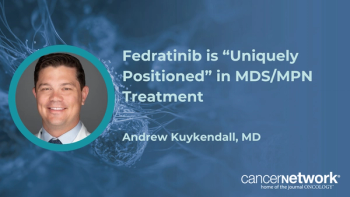
Fedratinib may target various proliferative pathways in MDS/MPN that other current standards of care miss, according to Andrew Kuykendall, MD.
A matching-adjusted indirect comparison highlighted linvoseltamab as a potentially effective treatment option for those with triple-class–exposed disease.
Patients in this multiple myeloma population who received DVRd achieved an overall MRD-negativity rate at 10–5 sensitivity of 61.1% vs 40.0% with VRd.

No grade 3 or higher CRS or ICANS events occurred among patients who received prophylactic tocilizumab before outpatient bispecific antibody treatment.
No dose-limiting toxicities, TEAE-related discontinuations, or deaths were observed in this pretreated lymphoma population.

Teclistamab monotherapy significantly improved PFS and OS vs investigator's choice in the phase 3 MajesTEC-9 trial in RRMM.

Results from the phase 3 SUCCESSOR-2 trial showed MeziKd reduced the risk of progression or death by 52% vs Kd in anti–CD38- and LEN-exposed RRMM.
In those with centrally confirmed lymphoma subtypes, the HR for PFS was 0.68, with a 24-month PFS rate of 72.7% vs 62.2% in favor of the tafasitamab combo.
Belantamab mafodotin plus triplet induction and maintenance yields responses in transplant-ineligible newly diagnosed multiple myeloma population.

Data from the phase 2 ERASMM trial support further evaluation of elranatamab among patients with high-risk smoldering multiple myeloma.

Matthew Matasar, MD, of Rutgers Cancer Institute, spoke about upcoming trials in lymphoma to look out for at the ASCO 2026 Meeting.

Presentations at the 2026 ASCO Annual Meeting may reveal key advances in the use of different bispecific antibodies and CELMoDs in multiple myeloma care.
A real-world analysis of teclistamab, elranatamab, and talquetamab showed comparable outcomes in relapsed or refractory multiple myeloma.

The EPCORE NHL-1 trial showed a 41% complete response rate with epcoritamab for patients with relapsed/refractory LBCL.
More follow-up data will better elucidate the impact of frontline use of hypomethylating agents in patients with myelodysplastic syndromes.
Epcoritamab monotherapy led to long-term disease-free remissions in patients with relapsed/refractory large B-cell lymphoma who achieved complete response at 2 years.
The median overall survival with cilta-cel exceeds 5 years among patients with relapsed/refractory multiple myeloma in the CARTITUDE-1 trial.

An expert panel highlights key presentations in multiple myeloma, lymphoma, and other hematologic malignancies at the 2025 ASCO Annual Meeting.
The 1-year progression-free survival rate for patients in the BCMA/GPRC5D naïve RP2D group was 95.0% and across all dose levels it was 74.1%.

Results from the EPCORE NHL-1 trial shared at the 2025 ASCO Annual Meeting found positive responses in patients with relapsed/refractory large B-cell lymphoma.
Results from part 1 dose level G of the MagnetisMM-6 trial found elranatamab, daratumumab, and lenalidomide to be safe and manageable in NDMM.
The KOMET-001 trial meets its primary end point of CR/CRh rate among patients with NPM1-mutated acute myeloid leukemia.
Daratumumab plus KRd improved MRD negativity and PFS vs KRd alone in patients with newly diagnosed multiple myeloma.