



Lymphoma
Latest News
Advertisement
Latest Videos


























































Advertisement
More News

A leader from the adolescent and young adult lymphoma space discusses how collaboration between adult and pediatric oncologists has transformed the field.
“When thinking about treatment options for refractory DLBCL you consider: Is it safe to give an older patient CAR T-[cell therapy]?,” said Jennifer Amengual, MD.
Clinicians focused on CLL, follicular lymphoma, and MCL gathered during a Frontline Forum to discuss the use of BTKi in each respective disease state.

Establishment of an AYA Lymphoma Consortium has facilitated a process to better understand and address gaps in knowledge for this patient group.
Adult and pediatric oncology collaboration in assessing nivolumab in advanced Hodgkin lymphoma facilitated the phase 3 SWOG S1826 findings.
Treatment paradigms differ between adult and pediatric oncologists when treating young adults with lymphoma.

Three patients treated at the first dose level of BAFF CAR-T cells experienced minimal adverse effects in a phase 1 study.
DLBCL is a genetically heterogeneous malignancy with multiple subtypes and recent investigations based on molecular profiles have opened the possibility for personalized therapy in this disease space.

Phase 2 data support a favorable risk/benefit profile with valemetostat in patients with relapsed/refractory peripheral T-cell lymphoma.
Phase 3 data show that nivolumab/AVD may also reduce long-term toxicities vs brentuximab vedotin/AVD in advanced Hodgkin lymphoma.

No evidence indicates synergistic toxicity when combining radiation with CAR T-cell therapy in this population, according to Timothy Robinson, MD, PhD.
The addition of radiotherapy to CAR T-cell therapy may particularly benefit patients with localized disease, according to Timothy Robinson, MD, PhD.
Timothy Robinson, MD, PhD, discusses how radiation may play a role as bridging therapy to CAR T-cell therapy for patients with relapsed/refractory DLBCL.
The FDA has set a Prescription Drug User Fee Act date in the first quarter of 2025 for the potential approval of acalabrutinib in previously untreated MCL.
Nausheen Ahmed, MD, discusses the FDA REMS mandate to help assess toxicity in patients receiving CAR T-cell therapy.

Complete responses were observed in a small cohort of patients with DLBCL who have previously received autologous CAR T-cell therapy.

Treatment with valemetostat yields responses across all PTCL subtypes in the phase 2 VALENTINE-PTCL01 trial.
Efficacy, safety, time, and cost were all factors assessed between subcutaneous and intravenous rituximab for patients with non-Hodgkin lymphoma.

The European Commission’s decision represents the first regulatory approval of odronextamab for patients with follicular lymphoma or DLBCL.
Brentuximab vedotin plus chemotherapy significantly improved HRQOL in both pediatric and young adult patients with high-risk Hodgkin lymphoma.

The approval of epcoritamab may impact treatment options in the R/R follicular lymphoma space, according to Tycel Phillips, MD.
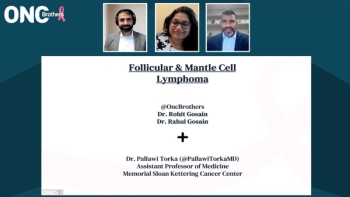
Pallawi Torka, MD, and the Oncology Brothers discuss the therapeutic landscape for patients with relapsed/refractory mantle cell lymphoma.
A hematologist-oncologist provides comprehensive insights on the treatment of newly diagnosed patients with mantle cell lymphoma.
The Oncology Brothers and Pallawi Torka, MD, review treatment options for patients with relapsed/refractory follicular lymphoma.
Pallawi Torka, MD, joins the Oncology Brothers to discuss patient workup and treatment practices in follicular lymphoma, highlighting the PRIMA study and the role of maintenance therapy.
Advertisement
Advertisement
Trending on CancerNetwork
1
Neoadjuvant Radiation May Improve Tolerability in Cholangiocarcinoma
2
Distal Extrahepatic Cholangiocarcinoma May Gain From Neoadjuvant Radiation
3
Hydrogel Spacer Receives FDA 510(k) Clearance for Prostate Cancer Radiotherapy
4
How Oncologists Can Navigate Patient Requests for Medical Aid in Dying
5