

This segment addresses one of the most rapidly evolving challenges in myeloma therapeutics: how to safely transition bispecific-treated patients between academic and community settings.
This segment addresses one of the most rapidly evolving challenges in myeloma therapeutics: how to safely transition bispecific-treated patients between academic and community settings.
This case-based discussion illustrates the practical management of a 72-year-old patient with high-risk MDS and TP53 mutation.
Experts discuss the impact of daratumumab on smoldering myeloma, exploring survival rates, treatment options, and the importance of clinical trials.
Experts discuss the strengths and limitations of the Matterhorn study, highlighting advancements in immunotherapy for upper GI cancer and future research directions.
This segment focuses on the practical, multidisciplinary coordination required to safely administer bispecific antibodies.
Explore the AKELA trial's findings on patient characteristics and the impact of daratumumab on progression-free survival in myeloma treatment.

Panelists discuss how post-CDK4/6 endocrine strategies increasingly rely on molecular profiling to guide therapy selection and optimize benefit in resistant disease.
This segment explores the critical role of patient support programs, insurance navigation, and balancing the convenience of oral HMAs with ongoing clinical oversight.
Surgeons and radiation oncologists can collaborate to discuss expected toxicity and surgical outcomes among patients with resectable gastric cancer.

Explore the promising long-term outcomes of the IMERG trial, highlighting Emtresat's efficacy and safety for lower-risk MDS patients.
Explore real-world outcomes of hemoglobin treatment in low-risk MDS patients, comparing luspatercept and ESA therapies in a recent study.
Panelists analyze real-world outcomes for patients receiving CAR T therapy in LBCL using US electronic medical record data from Flatiron Health. Discussion highlights differences and similarities in survival outcomes, safety events such as CRS and neurotoxicity, and healthcare resource utilization in outpatient settings for two key CAR T products. Faculty consider how these findings compare with clinical trial data and inform real-world treatment expectations.
Panelists discuss real-world treatment patterns for relapsed/refractory LBCL using the Flatiron Health electronic health record database. The conversation examines shifts in second- and third-line therapy use following CAR T approval, including declining reliance on salvage chemotherapy and transplant.

Health care professionals emphasize the importance of patient education on adverse effects of amivantamab and lazertinib to improve treatment adherence and outcomes.
A study published in JAMA Network Open showed that patient trust in physicians and hospitals dropped from 71.5% in April 2020 to 40.1% in January 2024.
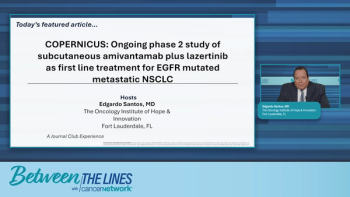
Explore the innovative Copernicus trial, evaluating subcutaneous Amivantamab plus Lazertinib for treating EGFR-mutated metastatic lung cancer.
Emphasizing critical thought over a conformity of thought in oncology may help prioritize and advocate for patients with cancer.
Explore the practical challenges of using oral hypomethylating agents, focusing on safety, access, and effective patient management strategies.
Explore the complexities of treating a 72-year-old woman with relapsed refractory multiple myeloma using bispecific antibody therapy.
The AQUILA trial explores a fixed-duration therapy for myeloma, aiming to balance effective treatment with reduced long-term toxicity for patients.
Panelists discuss how data from recent ESR1-mutant disease trials are influencing interpretation of survival end points, regulatory expectations, and real-world adoption of oral SERDs.
Oncologists discuss the significance of PCR and MPR rates in patient counseling, emphasizing treatment benefits and survival outcomes.
Panelists discuss how rapidly evolving guidelines are reshaping treatment pathways by preserving endocrine therapy as a backbone while introducing earlier use of combination regimens and ADCs.
Experts discuss the importance of PD-L1 testing in treatment decisions for gastric cancer, emphasizing personalized approaches and improved patient outcomes.
Early intervention in myeloma treatment addresses critical patient needs, highlighting new trial data and the importance of tailored therapies for better outcomes.
Explore the latest advancements in bispecific antibodies for treating BCMAs, highlighting their efficacy, administration frequency, and toxicity profiles.
Explore the differences between bispecific antibodies and CAR T-cell therapy, highlighting their unique benefits and administration processes.
Explore real-world outcomes of Luspatercept and second-line ESAs in treating low-risk MDS, revealing promising response rates and treatment insights.
Explore real-world outcomes of Luspatercept and second-line ESAs in treating low-risk MDS, revealing promising response rates and treatment insights.

Frequent follow-up to determine if lymphedema has developed is necessary to catch it early and begin rehabilitation processes.