scout

Videos

A panelist discusses how targeted therapies such as EGFR tyrosine kinase inhibitors have become the standard first-line treatment for patients with EGFR-mutated metastatic non–small cell lung cancer, offering improved outcomes compared with traditional chemotherapy.

Panelists discuss how amivantamab’s dual targeting of EGFR and MET may address resistance mechanisms and unmet needs in EGFR-mutated advanced non–small cell lung cancer (NSCLC), with Dr Scott highlighting its potential clinical benefits, while Squires shares insights on managing the adverse event profile and strategies for managing adverse effects in patients receiving intravenous (IV) amivantamab.

4 experts are featured in this series.

Panelists discuss how early-line chimeric antigen receptor T-cell therapy studies, including recent data from trials of cilta-cel (Popat et al) and ide-cel (Ailawadhi et al), are showing promising results in patients with relapsed/refractory multiple myeloma, suggesting potential benefits of moving these treatments into earlier therapeutic settings.

4 experts are featured in this series.

Panelists discuss how the treatment paradigm for newly diagnosed multiple myeloma (NDMM) has evolved from conventional chemotherapy to modern regimens incorporating novel agents like proteasome inhibitors, immunomodulatory drugs, and monoclonal antibodies while highlighting persistent challenges including optimizing treatment sequencing and addressing high-risk disease.

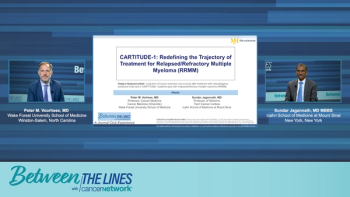
Panelists discuss the data surrounding the use of CAR-T therapy in earlier lines of treatment for relapsed/refractory multiple myeloma (R/R MM), including findings from the cilta-cel (Popat R, et al. ASH 2024 No. 1032; Mateos MV, et al. IMS 2024 No. OA-65), and Idel-cel (Ailawadhi S, et al. Blood 2024) studies, and share their thoughts on the implications of these results.

3 experts in this video

Panelists discuss how an early adverse event for this drug class no matter what the mechanism or target is, is cytokine release syndrome (CRS), and it tends to occur on a timescale that is predictable. When treating patients in the outpatient setting, they receive dexamethasone, given at the first fever, which is the first sign of cytokine release syndrome (CRS) and helps mitigate it.