Subsequent testing among patients in a prospective study may affirm the ability of cfDNA sequencing to detect cancers in those with Li-Fraumeni syndrome.

Your AI-Trained Oncology Knowledge Connection!


Subsequent testing among patients in a prospective study may affirm the ability of cfDNA sequencing to detect cancers in those with Li-Fraumeni syndrome.

cfDNA sequencing may allow for more accessible, frequent, and sensitive testing compared with standard surveillance in Li-Fraumeni syndrome.

Panelists discuss how VRd (bortezomib, lenalidomide, dexamethasone) remains the standard frontline regimen for transplant-eligible newly diagnosed multiple myeloma (NDMM) patients, though some now consider adding daratumumab (dara-VRd) in high-risk cases.

Panelists discuss key takeaways from the analysis of long-term results, noting that these findings may influence their recommendations for first-line regimens in EGFR-mutant metastatic non–-small cell lung cancer. They highlight how they engage patients in discussions about treatment options, considering efficacy and safety, while addressing remaining unmet needs in this therapeutic area.

Panelists discuss how insights from the INTERCEPT, BESPOKE, COSMOS-CRC-01, and GALAXY studies are advancing our understanding of circulating tumor DNA’s (ctDNA) utility in colorectal cancer management, from early detection to treatment monitoring.

Panelists discuss how the DYNAMIC trial data demonstrate the potential of circulating tumor DNA (ctDNA)–guided therapy to inform and optimize adjuvant chemotherapy decisions in patients with stage II colon cancer.

STX-478 showed efficacy in patients with advanced solid tumors regardless of whether they had kinase domain or helical PI3K mutations.

Panelists discuss key takeaways from the analysis and offer clinical pearls on incorporating prophylactic dexamethasone 8 mg into treatment with amivantamab and lazertinib for community colleagues.

Lisa J. States, MD, discussed further steps for improving early detection and screening methods in patients with Li–Fraumeni syndrome.

STX-478 may avoid adverse effects associated with prior PI3K inhibitors that lack selectivity for the mutated protein vs the wild-type protein.

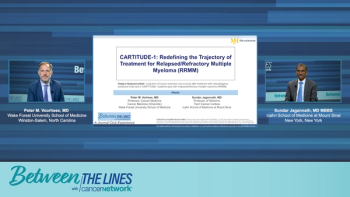
Panelists discuss how ide-cel, a CAR T-cell therapy, demonstrates promising real-world outcomes in patients with relapsed/refractory multiple myeloma, potentially offering a valuable treatment option for this challenging patient population.

Panelists discuss how novel therapeutic approaches and combination regimens are reshaping the landscape of treatment for patients with relapsed/refractory multiple myeloma, offering new hope for improved outcomes and quality of life.

Additional genetic testing measures and targeted therapies may improve outcomes for patients with diverse molecular subgroups of gastric cancers.

Phase 1 data may show the possibility of rationally designing agents that can preferentially target PI3K mutations in solid tumors.

Funding a clinical trial to further assess liquid biopsy in patients with Li-Fraumeni syndrome may help with detecting cancers early across the board.

Panelists discuss how community practices establish protocols and processes for ongoing monitoring and management of potential long-term complications or adverse events from bispecific therapy.

Panelists discuss how academic centers approach the initial consultation and evaluation process for patients referred for bispecific therapy from community practices.

Panelists discuss how transitioning patients with multiple myeloma from community to academic settings faces challenges including communication gaps, differences in treatment approaches, patient reluctance, and logistical hurdles.

Panelists discuss recent updates in the management of relapsed/refractory multiple myeloma, focusing on key studies such as MonumenTAL-2 for talquetamab, long-term follow-up data from the phase 1/2 MajesTEC-1 for teclistamab, and findings from MagnetisMM-3 regarding elranatamab.

Experts on multiple myeloma outline current challenges in determining the optimal treatment strategy for patients with relapsed/refractory disease who are eligible for bispecifics and CAR T-cell therapy.

Panelists discuss how community practices implement protocols and processes to monitor and manage potential long-term complications or adverse events associated with bispecific therapy, focusing on patient follow-up, adverse event reporting, and ongoing risk assessment.

Shaji Kumar, MD, reviews data from cohort C of CARTITUDE-2 and a real-world study evaluating ide-cel in patients with relapsed/refractory multiple myeloma.

Panelists discuss how data from the long-term CARTITUDE-4 study update in multiple myeloma (MM) highlight the sustained efficacy and safety of ciltacabtagene autoleucel, reinforcing its role as a promising treatment option for patients with lenalidomide-refractory disease.

Data from the SPOTLIGHT and GLOW trials reveal that zolbetuximab increased survival in patients with CLDN18.2-positive gastric or GEJ adenocarcinoma.

Shannon N. Westin, MD, discusses chemotherapy options for endometrial cancer as well as the results of her phase 3 DUO-E trial.

Shannon N. Westin, MD, discusses how patient considerations for immunotherapy treatment involve evaluating individual health profiles, potential adverse effects, and the importance of personalized approaches to enhance treatment efficacy and patient quality of life.

Shannon N. Westin, MD, discusses how neoadjuvant treatment considerations for endometrial cancer can improve surgical outcomes and patient prognosis through the use of personalized, multidisciplinary approaches tailored to individual tumor characteristics.

Shannon N. Westin, MD, discusses the molecular classification of endometrial cancer.

Shannon N. Westin, MD, provides an overview of endometrial cancer to the Oncology Brothers.

The incorporation of zolbetuximab in addition to chemotherapy has shown benefit in patients with Claudin 18.2–positive gastric cancers in clinical trials.