Panelist discusses how the DESTINY-PanTumor02 study enrolled 267 patients with different tumor types, including endometrial, cervical, ovarian, bladder, biliary tract, and pancreatic cancer.

Your AI-Trained Oncology Knowledge Connection!


Panelist discusses how the DESTINY-PanTumor02 study enrolled 267 patients with different tumor types, including endometrial, cervical, ovarian, bladder, biliary tract, and pancreatic cancer.

Panelist discusses how HER2-directed tumor-agnostic therapies represent an emerging treatment paradigm focused on targeting HER2 mutations regardless of cancer type. Current agents such as trastuzumab deruxtecan show promise across multiple tumor types that express HER2, moving beyond traditional cancer-specific approaches. This precision medicine strategy may expand treatment options and improve outcomes for patients with HER2-altered cancers who previously had limited therapeutic choices.

Panelist discusses how the DESTINY-Lung02 trial was a dose optimization study where patients with HER2-mutated non–small cell lung cancer (NSCLC) were randomly assigned to a starting dose of 5.4 mg/kg vs 6.4 mg/kg of trastuzumab deruxtecan (T-DXd). DESTINY-Lung03 was a frontline study for HER2 overexpression in NSCLC looking at different combinations of treatment with T-DXd and immunotherapy agents with or without chemotherapy.

Panelist discusses how HER2 testing evaluates protein overexpression, gene amplification, and mutations. Although breast and gastric cancers typically show overexpression/amplification, other tumors more commonly harbor mutations.

Introduction to HER2-Directed Tumor-Agnostic Approaches

Panelists discuss the clinical scenario of TP53-mutant acute myeloid lymphoma (AML), focusing on treatment approaches and key challenges in managing this high-risk patient group.

Panelists discuss the clinical scenario of newly diagnosed acute myeloid lymphoma (AML) with an NPM1 mutation, exploring treatment strategies and key considerations for managing this patient population.

Panelists discuss the treatment landscape in non–clear cell RCC, highlighting how treatment approaches differ from clear cell RCC, relevant data from frontline settings, and emerging trials of note in this subset of patients.

Panelists discuss essential patient education when initiating combination regimens for RCC, addressing overlapping and unique toxicity considerations in IO/TKI combinations, counseling strategies for monitoring and communicating potential adverse events (AEs), key AEs for patients to watch for, and strategies for proactive toxicity mitigation and management.

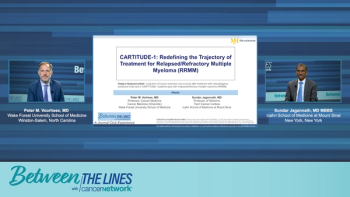
Panelists discuss how bispecific antibodies targeting B-cell maturation agent, GPRC5D, and FcRH5 are transforming relapsed/refractory multiple myeloma treatment (R/R MM) with promising efficacy, manageable safety profiles, and convenient off-the-shelf administration.

Dr Mohan asks Dr Nadeem about the selection process among bispecific antibodies, the factors influencing decision-making, and the use of talquetamab, teclistamab, or elranatamab in specific patient subgroups, followed by a discussion with Dr Mann on next therapeutic steps if a patient experiences disease progression on talquetamab.

Dr Mohan and Dr Mann discuss the current therapeutic landscape for relapsed/refractory multiple myeloma (R/R MM), alternative treatment strategies, and the real-world performance, advantages, and challenges of incorporating talquetamab into treatment protocols.

In considering patients’ busy lives, AI may help reduce the number of visits required to fully stage and grade cancers.

Acalabrutinib improves efficacy in high-risk patients like those with TP53 mutations, those with complex cytogenetics, and those with high proliferative rates in MCL.

Panelists discuss recent data updates on transplant-ineligible and deferred newly diagnosed multiple myeloma (NDMM), including findings from the CEPHEUS and IMROZ studies, and explore the clinical significance of minimal residual disease negativity as a prognostic and actionable factor in treatment decision-making for NDMM.

Tycel Phillips, MD, questioned how the regimen of acalabrutinib, bendamustine, and rituximab would compare with taking the drugs separately in mantle cell lymphoma.

Panelists discuss how to approach patients who show inadequate response to initial erythropoiesis-stimulating agent (ESA) therapy, including assessment strategies and potential next steps in treatment modification.

Standardizing surgical outcomes and better training oncologic surgeons may be accomplished through the use of AI.

Panelists discuss a clinical scenario involving a 56-year-old male man with myeloma and del 17p deletion, treated with RVD induction, auto transplant, and lenalidomide maintenance, who relapsed after 2 years and is now referred to discuss chimeric antigen receptor (CAR) CAR-T versus vs standard therapy, sharing key takeaways and pearls from the case.

Panelists discuss successful collaborations between academic centers and community practices in the context of (chimeric antigen receptor (CAR) T-cell therapy for multiple myeloma, key lessons learned in integrating CAR T therapy into the treatment landscape, and future plans for expanding CAR T therapy’s role in earlier lines of multiple myeloma treatment.

Panelists discuss their institution’s approach to co-management and co-monitoring of (chimeric antigen receptor (CAR) -T patients, strategies to facilitate seamless transitions of care between academic centers and community practices, common challenges in the CAR -T referral process and solutions, and advice for community physicians on the timing and preparation for patient referrals.

Panelists discuss how the chimeric antigen receptor T-cell referral pathway progresses from initial community physician contact through patient evaluation and final selection, highlighting the key steps and considerations in the institutional workflow process.

Panelists discuss intracranial efficacy data with tucatinib and T-DXd in the treatment of brain metastases, highlighting key findings and their implications for clinical practice.

Panelists discuss the strategic screening and management of brain metastases in HER2+ breast cancer, focusing on current approaches and emerging strategies to address this complication.

The poly-ICLC trial seeks to develop a delivery mechanism to prostate cancer through different biomarkers.

“Some of the early data that came out of the [ECHO] trial that led to this approval does suggest that it may be beneficial in some high-risk patients,” Tycel Phillips, MD, said.

Panelists discuss how challenges in the CAR T referral process include delayed referrals, patient logistics, and managing expectations. One institution addresses these through streamlined communication, patient education, and clear referral guidelines. Community physicians should refer early on, ensure candidacy, and collaborate closely to optimize outcomes.

Panelists discuss how, a collaborative approach to co-managing and co-monitoring patients receiving CAR-TCAR T-cell therapy patients, ensuring continuity of care as they transition to community settings. We They employ detailed care plans, electronic health records integration, and regular follow-ups with community providers to facilitate seamless transitions.

Panelists discuss how patient selection criteria and individual characteristics help determine whether ide-cel or cilta-cel is the more appropriate chimeric antigen receptor T-cell therapy choice for early-line treatment in patients with multiple myeloma.

Panelists discuss how CAR T-cell therapy involves engineering a patient’s T cells to target cancer cells. The process includes cell collection, genetic modification, expansion, and reinfusion and streamlines the process with integrated workflows. Bridging therapy is provided in-house to treat patients awaiting CAR-T infusion.