

In this segment, Dr. Alexander Spira is joined by Dr. Ticiana Leal, Dr. Edward Kim, and Dr. Natalie Vokes to discuss clinical decision-making around neoadjuvant therapy in early-stage EGFR-mutated non–small cell lung cancer (NSCLC).
In this segment, Dr. Alexander Spira is joined by Dr. Ticiana Leal, Dr. Edward Kim, and Dr. Natalie Vokes to discuss clinical decision-making around neoadjuvant therapy in early-stage EGFR-mutated non–small cell lung cancer (NSCLC).
In this segment, Dr. Alexander Spira and Dr. Ticiana Leal focus on the importance of multidisciplinary coordination in managing early-stage EGFR-mutated non–small cell lung cancer (NSCLC).
JNJ-1900 may avoid the main limitations observed with other radiosensitizers and radioprotectors, according to Benjamin Cooper, MD.
In this segment, Dr. Alexander Spira and Dr. Edward Kim discuss the critical role of early and comprehensive biomarker testing in the management of early-stage EGFR-mutated non–small cell lung cancer (NSCLC).

Mina Fam, MD, discussed his use of MRI and genomic testing to inform his use of HIFU focal therapies vs more radical alternatives.

Jamin C. Morrison, MD, discussed the shift toward personalized cancer vaccines in melanoma.
In this segment, Dr. Alexander Spira and Dr. Natalie Vokes examine how outcomes with adjuvant EGFR tyrosine kinase inhibitors translate from clinical trials into real-world practice in early-stage EGFR-mutated non–small cell lung cancer (NSCLC).
In this segment, Dr. Alexander Spira and Dr. Ticiana Leal discuss how clinicians interpret EGFR tyrosine kinase inhibitor (TKI) data across different clinical trials and apply these findings to early-stage EGFR-mutated non–small cell lung cancer (NSCLC).

The panel debates how real-world differences in efficacy, vein-to-vein time, manufacturing reliability, and toxicity should influence selection between the two second-line CAR T options for early relapsed/refractory LBCL. One side argues that efficacy is broadly similar and that lower all-grade CRS/neurotoxicity, especially for outpatient delivery, favors the less toxic product, whereas the other emphasizes faster manufacturing, longer follow-up experience, and the importance of overall survival data in driving decisions. The discussion converges on individualized selection based on the patient in front of you (disease tempo, fitness, logistics, and center capacity), while acknowledging the lack of head-to-head randomized comparisons.
According to Jeff P. Sharman, MD, determining whether a patient requires inpatient or outpatient admission is a critical concern in community practice.
Natalie Berger, MD, discusses the evolving landscape of ADC sequencing in breast cancer, the role of HER2 expression, and the "sandwich approach" to treatment.

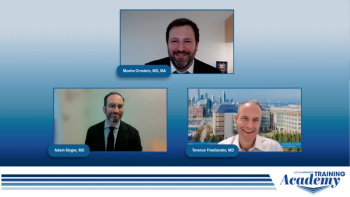
In this segment on advanced renal cell carcinoma, Dr. Ornstein raises the important issue of real-world treatment attrition, noting that not all patients are able to receive subsequent lines of therapy after disease progression. He frames this as a key consideration when selecting first-line treatment.
In this segment on advanced renal cell carcinoma, Dr. Ornstein shifts the discussion to the role of treatment sequencing when selecting first-line therapy. He raises the question of how anticipated second-line options may influence initial treatment decisions in the context of multiple effective frontline regimens.
Frequent hydration, salivary gland stimulation, and overnight humidifier use are strategies Bradley J. Stish, MD, employs to manage dry mouth.

In this segment, the panel discusses how complex treatment education is operationalized in routine practice for patients with EGFR mutated metastatic non-small cell lung cancer.
Continuing to implement prophylactic measures is necessary to maintain the benefit of subcutaneous amivantamab plus lazertinib in this NSCLC population.
In this segment, Dr. Devarakonda asks Dr. Rous to explore how treatment schedules and dosing flexibility influence shared decision making and long term adherence in EGFR mutated metastatic non-small cell lung cancer.
Bradley J. Stish, MD, emphasized the role of decision-making processes between physicians and patients when deciding between 2.5 and 5 mg of oxybutynin.
Ryan H. Moy, MD, PhD, is the principal investigator of a phase 2 trial evaluating defactinib plus avutometinib in patients with diffuse gastric/GEJ carcinoma.
In this segment, Dr. Alexander Spira and Dr. Edward Kim discuss how the clinical development of osimertinib across multiple disease stages has influenced treatment expectations in early-stage EGFR-mutated non–small cell lung cancer (NSCLC).
Panelists engage in a structured debate on whether CAR T-cell therapy for aggressive large B-cell lymphoma should be administered in the inpatient or outpatient setting. Team NYC argues for inpatient treatment in higher-risk or socially complex cases, citing logistical barriers, caregiver limitations, and the need to manage serious toxicities such as CRS and ICANS. Team Roswell counters that outpatient programs can safely expand access, reduce hospital-related complications, and improve patient acceptance of CAR T, prompting a broader discussion on evolving safety data, real-world logistics, and changing regulatory requirements.
In this segment, Alexander Spira, MD, PhD, engages Natalie Vokes, MD, in a discussion on the distinct biology of EGFR-mutated non–small cell lung cancer and how it informs treatment decisions in the early-stage setting.
In this segment on advanced renal cell carcinoma, Dr. Ornstein guides the discussion toward differentiating available frontline treatment options, focusing on the choice between dual immune checkpoint inhibitor therapy and combinations of immunotherapy with VEGF receptor targeted therapies.
In this opening segment on advanced renal cell carcinoma, Ornstein introduces the evolving frontline treatment landscape, highlighting the expanded role of immune checkpoint inhibitor–based combinations and VEGF receptor–targeted therapies.