
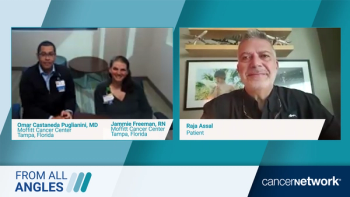
Panelists discuss the rationale for considering chimeric antigen receptor (CAR) T-cell therapy in standard-risk multiple myeloma and how health care providers help patients understand and prepare for the decision to pursue CAR T-cell treatment.
Panelists discuss the rationale for considering chimeric antigen receptor (CAR) T-cell therapy in standard-risk multiple myeloma and how health care providers help patients understand and prepare for the decision to pursue CAR T-cell treatment.
Investigators are currently evaluating mosunetuzumab in relapsed disease or comparing it with rituximab in treatment-naïve follicular lymphoma.

Panelists discuss how a patient and their medical team collaborated to evaluate the differences between ide-cel and cilta-cel CAR T therapies to make an informed treatment decision.
Panelists discuss how clinical trial data from CARTITUDE-1, CARTITUDE-4, and KarMMa-3 demonstrate the efficacy of CAR T therapies cilta-cel and ide-cel in multiple myeloma, comparing their real-world outcomes and considering patient-specific factors for treatment selection.
Compared with second-generation tyrosine kinase inhibitors, asciminib was better tolerated in patients with chronic myeloid leukemia.
The 2 main pafolacianine components, a folate analog and a dye, are commonly used in other medical applications.
Using bispecific antibodies before or after CAR T-cell therapy in multiple myeloma is an area of education for community oncologists.

Panelists discuss the adverse effects experienced by a patient undergoing treatment with capecitabine (Xeloda), trastuzumab (Herceptin), and tucatinib (Tukysa), along with the strategies employed to manage those adverse effects, while also addressing patient follow-up procedures, including the frequency of visits, typical labs and imaging ordered, concerning symptoms and lab results, and the outcomes of the patient's most recent follow-up appointment.
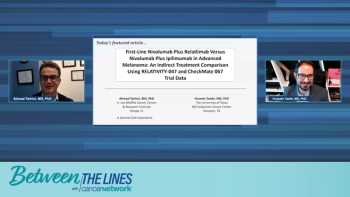
Panelists discuss how dual immunotherapy for melanoma, including combinations like nivolumab plus ipilimumab or nivolumab plus relatlimab, requires careful consideration of sequencing decisions based on factors such as tumor burden, patient health status, and potential toxicity profiles.
Panelists discuss how patients are prepared for treatment, the adverse effects associated with different agents and combination regimens that they educate patients about, the process of administering treatment for HER2+ breast cancer, and the overall approach to monitoring and managing adverse effects throughout the treatment journey.
Panelists discuss how the indirect treatment comparison of RELATIVITY-047 and CheckMate 067 suggests that nivolumab plus relatlimab may provide similar efficacy to nivolumab plus ipilimumab in advanced melanoma, with a potentially better safety profile.
Panelists discuss how unmet needs in glioma treatment persist despite recent advances, highlighting key areas for future research and development to improve outcomes and quality of life for patients with gliomas.

Bulkiness of disease did not appear to impact PFS outcomes with ibrutinib plus venetoclax in the phase 2 CAPTIVATE study.
Panelists discuss how the patient’s journey with multiple myeloma begins with an initial diagnosis followed by first-line treatments and how this informs the decision to consider chimeric antigen receptor T-cell therapy as a subsequent option in their treatment path.
Panelists discuss the progress of the BRIDGET trial and its potential impact on HER2-positive breast cancer patients, focusing on the anticipated data and its implications for treatment strategies in this population.
Panelists discuss how ongoing trials may reshape the treatment landscape for HER2-altered NSCLC, particularly regarding the roles of ADCs and TKIs in managing both HER2-mutated and HER2-overexpressing NSCLC.
Panelists discuss a brief overview of recent data on combination systemic therapies for the treatment of advanced HER2+ breast cancer, including studies such as DESTINY-Breast03, DEBBRAH, HER2CLIMB-02, and EMILIA, and they analyze which patient populations may benefit most from each therapy option based on the available data.
An intravenous infusion administered prior to surgery enables treatment to occur in a normal time frame without the need for additional procedural time.
Optimal cancer survivorship care may entail collaboration between a treating oncologist and a cancer survivorship expert.
Panelists discuss how health care providers engage in vital conversations with patients about CAR T therapy, focusing on comprehensive education, emotional support, and clear communication about the treatment journey ahead.
Panelists discuss how the symptoms of a patient with multiple myeloma led to their initial diagnosis and the progression of various treatments they underwent before becoming a candidate for CAR T therapy.
Panelists discuss how the patient’s journey with multiple myeloma begins with an initial diagnosis followed by first-line treatments and how this informs the decision to consider chimeric antigen receptor T-cell therapy as a subsequent option in their treatment path.

In an era where medical records are digitalized, artificial intelligence has the potential to identify patterns that can locate at-risk patients with pancreatic cancer.

The relatively inexpensive nature of liquid biopsy may allow for more frequent screening among individuals who are at risk of developing pancreatic cancer.
There are certain markers that can point to a greater risk of pancreatic cancer like BRCA1/2, and diabetes, according to Brian M. Wolpin, MD.
Survivors of cancer may experience an increased risk of having organ, cardiac, or lung disease following prior anti-cancer therapy.
The pancreatic cancer field may not be far from seeing the use of non-invasive blood tests in pancreatic cancer, said Ajay Goel, PhD, AGAF.
Dr Nadeem discusses his approach to sequencing bispecifics vs chimeric antigen receptor T-cell therapies, including B-cell maturation antigen (BCMA) and non-BCMA bispecifics, and the factors he considers, followed by key takeaways from a recent meeting on bispecifics in relapsed/refractory multiple myeloma, focusing on dosing, adverse event management, and clinical pearls for oncologists.
Dr Nadeem discusses his case details and shares his initial thoughts. He then reviews the current treatment landscape for relapsed/refractory multiple myeloma, including his experience with bispecifics in practice and his challenges in using them.
Panelist discusses the current acceleration of new therapies for multiple myeloma. In the future, oncologists will be able to use CAR T and bispecific therapies more efficiently, and they will also have new tools including new CAR T therapies and bispecifics that will require less manufacturing time, have fewer AEs, and be more effective regarding the targeted disease.