

Zoldonrasib has elicited good responses and progression-free survival in an area with a large unmet need, said Jonathan Wesley Riess, MD, MS.
Zoldonrasib has elicited good responses and progression-free survival in an area with a large unmet need, said Jonathan Wesley Riess, MD, MS.

Timothy A. Yap, MBBS, PhD, FRCP, presented data from the MYTHIC trial, demonstrating a 60% ORR at the RP2D in patients with CCNE1-amplified PROC.
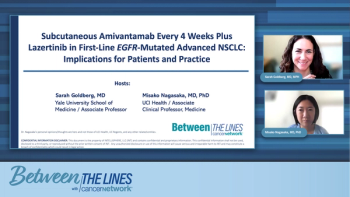
New data show amivantamab+lazertinib boosts survival vs osimertinib in EGFR lung cancer, with Q4W subcutaneous dosing and side-effect tips.
New data show amivantamab plus lazertinib boosts survival and brain control in EGFR+ lung cancer, with convenient Q4W injection tips.

Muhammad Umair Mushtaq, MD, discussed the evolution of TIL therapy in melanoma, focusing on first-line treatment potential and immune fitness.
In this closing segment on advanced renal cell carcinoma, Dr. Ornstein synthesizes key themes from the case discussion, emphasizing how disease biology and clinical presentation guide second-line treatment decisions. He highlights that patients with early progression after frontline therapy represent a higher-risk group that often requires a more aggressive treatment approach.
In this case-based segment on advanced renal cell carcinoma, Dr. Ornstein introduces a patient with high disease burden who progresses within 8 months of frontline immunotherapy plus VEGF receptor targeted therapy, highlighting a more aggressive disease course. He emphasizes that early progression and limited depth of response raise concern for more refractory disease biology.
Jennifer Effie Amengual, MD, detailed a clinical trial evaluating the dual epigenetic combination of tazemetostat and belinostat for the treatment of T-cell lymphomas.

There are reimbursement and infrastructure challenges in oncology care, with the need for systemic changes to provide patients with lifesaving behavioral interventions.

Using T-cell–redirecting therapies in less heavily pretreated populations may be a beneficial space to capitalize on, said Barry Paul, MD.

Results from the CHALLENGE trial showed that activity can reduce cancer recurrence for patients with colorectal, breast, and prostate cancers.
Previous data showed deep MRD-negative responses among patients with pretreated relapsed/refractory multiple myeloma who received cevostamab.

Jennifer A. Ligibel, MD, discussed the complex link between weight loss and cancer risk, exploring data from bariatric surgery and the emerging role of GLP-1s.
In this forward-looking segment on advanced renal cell carcinoma, Dr. Ornstein asks the panel to consider how treatment decisions may evolve if newer combination therapies become available in the second-line setting. He introduces the potential role of lenvatinib combined with belzutifan and asks how this regimen might fit into clinical practice.
In this segment on advanced renal cell carcinoma, Dr. Ornstein asks how clinicians differentiate among VEGF receptor targeted therapies when selecting treatment for patients with slower disease progression after prior immunotherapy. He highlights the perception that different TKIs may vary in both efficacy and toxicity.

Reducing vein-to-vein time and expanding manufacturing capacity represent ongoing challenges to optimizing the use of cellular therapy across indications.
Ralph V. Boccia, MD, FACP, explained how his team utilizes patient monitoring kits to manage CRS and keep patients out of the hospital.
Asfar Azmi, PhD, discusses the tricomplex mechanism of daraxonrasib and its impact on overall survival for patients with pancreatic cancer.
Shikha Gupta, PhD, discussed the mechanistic rationale for combining palbociclib and RMC-5552 in translocation renal cell carcinoma (tRCC).

Isaac Allen, PhD, analyzed how postdiagnostic lifestyle behaviors may affect oncological outcomes, including patient health-seeking behavior influences.

CancerNetwork, AJMC, and Pharmacy Times are producing The Bispecifics Network, where Ralph V. Boccia, MD, FACP, breaks down the importance of this initiative.
In this case-based segment on advanced renal cell carcinoma, Dr. Ornstein presents a patient with intermediate-risk disease who experienced progression after 14 months of frontline dual immune checkpoint inhibitor therapy. He highlights the importance of interpreting prior treatment response and clinical status when selecting second-line therapy.