

Expert Interviews
The FIBI technology, created by Farzad Fereidouni, PhD, when combined with AI eliminates the need for frozen sections and other labor-intensive oncology surgery practices.
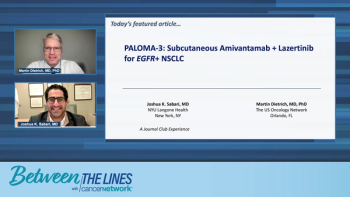
Panelists discuss how PALOMA-3, a phase 3 randomized clinical trial, was designed to evaluate subcutaneous vs intravenous amivantamab, both in combination with lazertinib, in patients with refractory EGFR–mutated non–small cell lung cancer.
Panelists discuss how managing adverse events and selecting optimal treatment strategies remain key challenges in front-line EGFR-mutated, non–small cell lung cancer (mNSCLC) therapy, particularly when weighing the efficacy and toxicity profiles of available targeted therapies.
Additional progression-free survival data from the phase 3 BREAKWATER trial will be presented at future meetings.
Regardless of disease burden or disease progression speed on front-line therapy, trastuzumab deruxtecan appears effective in HER2-low breast cancer.
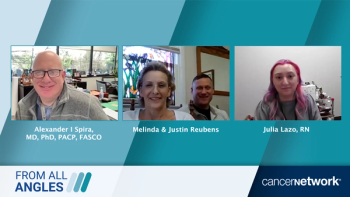
Panelists discuss Melinda's treatment journey for advanced EGFR-mutant NSCLC, including the specific treatments she received and her responses, while Dr. Spira provides a high-level overview of systemic therapies for the condition, highlighting the role of amivantamab and how management strategies are tailored based on patient and disease characteristics, with treatment decisions guided by available data.
Panelists discuss the educational resources provided to patients, with Julia explaining how she tailors patient education on breast cancer based on individual needs and preferences, while Melinda shares the courses, books, and other resources that helped her best educate herself during her cancer journey.

Panelists discuss evolving frontline treatment strategies and future directions in HER2+ breast cancer, focusing on the latest advancements and emerging approaches in managing this subtype.
Panelists discuss how to develop treatment strategies for patients with ring sideroblasts and genetic abnormalities, focusing on the role of specialized therapies and the importance of molecular testing in guiding clinical decisions.
Panelists discuss a clinical scenario involving tucatinib-based regimens in the management of brain metastases in the second-line metastatic setting, exploring treatment options and clinical decision-making.

Panelists discuss how bridging therapy during the CAR T manufacturing waiting period requires careful patient-specific decisions about whether to use chemotherapy, targeted agents, or observation alone, based on disease aggressiveness, patient condition, and expected manufacturing timeframes.

Panelists discuss how chimeric antigen receptor (CAR) T-cell therapy’s mechanism of action and treatment workflow requires extensive institutional coordination, from patient selection through bridging therapy and infusion, with varied approaches to managing patients during the manufacturing period across different centers.

Panelists discuss how recent findings from the GMMG-HD7 trial comparing isatuximab-RVd vs RVd have shaped treatment decision-making in patients with multiple myeloma by providing comparative efficacy and safety data between the 2 regimens.
Panelists discuss how CAR T-cell therapy, a groundbreaking immunotherapy treatment, works by extracting a patient’s T cells, genetically modifying them to target cancer cells, and reinfusing them back into the patient’s body through a process that involves close monitoring and specialized care
Panelists discuss how the choice between isatuximab-based quadruplet and daratumumab-based regimens in multiple myeloma treatment depends on clinical trial data comparing Isa-KRd vs KRd, with particular emphasis on efficacy outcomes and patient-specific factors that might influence treatment selection.
Panelists discuss how successful chimeric antigen receptor (CAR) T referrals require close coordination between community physicians and treatment centers, involving detailed patient screening, insurance authorization, and careful timing of apheresis and manufacturing to optimize outcomes.
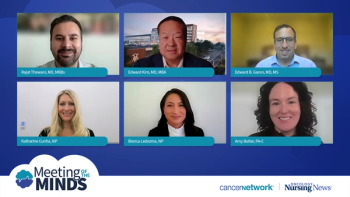
Dr. Kim shares his clinical experience with amivantamab in real-world practice for EGFR+ NSCLC, discussing both the benefits and challenges of incorporating it into treatment protocols.
Dr. Kim reviews key clinical evidence from the FLAURA trial for osimertinib as a first-line therapy in EGFR+ metastatic NSCLC and discusses the MARIPOSA 2 trial supporting amivantamab with chemotherapy as the preferred second-line option.
Panelist discusses how HER2-directed tumor-agnostic treatments are likely to see expanded applications across multiple cancer types, driven by improved biomarker testing and emerging clinical evidence. This approach may become increasingly personalized through enhanced molecular profiling, potentially leading to more precise patient selection and combination strategies.
Panelist discusses how the DESTINY-PanTumor02 study enrolled 267 patients with different tumor types, including endometrial, cervical, ovarian, bladder, biliary tract, and pancreatic cancer.
Panelist discusses how HER2-directed tumor-agnostic therapies represent an emerging treatment paradigm focused on targeting HER2 mutations regardless of cancer type. Current agents such as trastuzumab deruxtecan show promise across multiple tumor types that express HER2, moving beyond traditional cancer-specific approaches. This precision medicine strategy may expand treatment options and improve outcomes for patients with HER2-altered cancers who previously had limited therapeutic choices.
Updates and Clinical Implications of DESTINY-Lung02 and DESTINY-Lung03 Trials
Published: | Updated:
Panelist discusses how the DESTINY-Lung02 trial was a dose optimization study where patients with HER2-mutated non–small cell lung cancer (NSCLC) were randomly assigned to a starting dose of 5.4 mg/kg vs 6.4 mg/kg of trastuzumab deruxtecan (T-DXd). DESTINY-Lung03 was a frontline study for HER2 overexpression in NSCLC looking at different combinations of treatment with T-DXd and immunotherapy agents with or without chemotherapy.
Panelist discusses how HER2 testing evaluates protein overexpression, gene amplification, and mutations. Although breast and gastric cancers typically show overexpression/amplification, other tumors more commonly harbor mutations.
Introduction to HER2-Directed Tumor-Agnostic Approaches
Panelists discuss the clinical scenario of TP53-mutant acute myeloid lymphoma (AML), focusing on treatment approaches and key challenges in managing this high-risk patient group.
Panelists discuss the clinical scenario of newly diagnosed acute myeloid lymphoma (AML) with an NPM1 mutation, exploring treatment strategies and key considerations for managing this patient population.

Panelists discuss the treatment landscape in non–clear cell RCC, highlighting how treatment approaches differ from clear cell RCC, relevant data from frontline settings, and emerging trials of note in this subset of patients.
Panelists discuss essential patient education when initiating combination regimens for RCC, addressing overlapping and unique toxicity considerations in IO/TKI combinations, counseling strategies for monitoring and communicating potential adverse events (AEs), key AEs for patients to watch for, and strategies for proactive toxicity mitigation and management.

Panelists discuss how bispecific antibodies targeting B-cell maturation agent, GPRC5D, and FcRH5 are transforming relapsed/refractory multiple myeloma treatment (R/R MM) with promising efficacy, manageable safety profiles, and convenient off-the-shelf administration.
Advertisement
Advertisement
Trending on CancerNetwork
1
Building a Low-Dose Radiation Therapy Program for Benign Disease
2
Robot-Assisted Hysterectomy Yields Fewer Intraoperative Complications in Cervical Cancer
3
COPERNICUS Safety Data and Pragmatic Trial Design
4
Sequencing Bispecifics and CAR T-Cell Therapy in Myeloma and AL Amyloidosis
5