

Panelists discuss how differences in BCMA-directed CAR T constructs (including binding configuration and expansion kinetics) can influence toxicity timing, monitoring needs, and real-world product selection.
Panelists discuss how differences in BCMA-directed CAR T constructs (including binding configuration and expansion kinetics) can influence toxicity timing, monitoring needs, and real-world product selection.

Soumen Das, MBBS, MS, FACS, discussed the BC-RADS-2 study and its potential to transform early breast cancer detection in low- and middle-income countries.
Clinical Scenario A: 77-year-old male with newly diagnosed LR-MDS
Experts debate the optimal dose escalation strategy for Luspatercept in treating low-risk MDS, emphasizing patient-centric approaches and long-term outcomes.
Panelists review a patient with relapsed LBCL presenting with symptomatic disease and logistical barriers to treatment access. The discussion highlights how proximity to treatment centers, work demands, and concerns about toxicity influence therapy selection. Faculty consider practical approaches to balancing efficacy, access, and quality-of-life considerations.
Experts discuss the benefits of combination therapies for non-small cell lung cancer, emphasizing improved survival rates and patient quality of life.
Panelists evaluate a young patient with early relapsed LBCL following frontline therapy who is curious about CAR T. Discussion focuses on high-risk disease features, long-term treatment goals, and considerations such as family planning and treatment durability. Faculty debate how these factors influence selection of second-line therapy.
Explore the latest insights on combination therapies for metastatic cancer, focusing on long-term management and patient outcomes in challenging cases.
Caroline Chung, MD, MSc, FRCPC, CIP, explores how AI in diagnostic imaging may help with accelerating scan acquisition and extracting subvisual features.
Caroline Chung, MD, MSc, FRCPC, CIP, discussed how AI is transforming radiotherapy, ranging from uniform dosing to personalized, immune-sparing strategies.
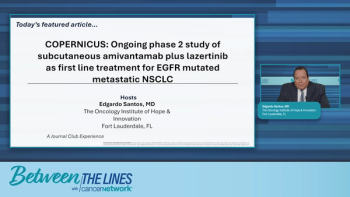
Discover how Copernicus enhances patient care with innovative treatments and supportive practices for advanced EGFR mutation cases.
Discover how specialized cancer care, including nurse navigators and telehealth, enhances patient outcomes and quality of life post-treatment.
Here, the panel turns to one of the most debated questions surrounding bispecific antibodies: how long should patients remain on therapy? Jagannath raises a scenario involving a patient who achieves MRD-negative complete remission after 1 and 2 years of therapy, prompting discussion about whether to continue, taper, or discontinue treatment.

Panelists discuss how identifying high-risk subgroups enables more precise selection of maintenance therapies that maximize progression-free survival while accounting for biomarker differences.
Explore the latest findings on smoldering myeloma treatments, including lenalidomide's effectiveness and the importance of patient monitoring in clinical trials.
The panel discusses the case of a 67-year-old female patient diagnosed with high-risk chronic myelomonocytic leukemia (CML-1) who presents with intermediate risk scores and abnormal blood counts, including elevated white blood cells, mild thrombocytopenia, and anemia.
This segment tackles one of the most nuanced decisions in modern myeloma treatment: determining when to use BCMA CAR T-cell therapy versus a BCMA bispecific antibody.
Panelists discuss how emerging neoadjuvant and adjuvant data in HER2-positive breast cancer are challenging traditional standards and supporting earlier use of highly effective agents.
This segment continues the discussion of high-risk MDS management, focusing on how clinicians define failure of HMAs and determine next steps in therapy, particularly in patients with TP53 mutations.
Daratumumab shows promise in managing smoldering myeloma, balancing infection risks and adverse effects while offering a preferable alternative to lenalidomide.
Experts discuss the management of immune-mediated side effects in perioperative cancer treatment, emphasizing patient care and monitoring strategies.
Ongoing studies are evaluating teclistamab-based regimens in the frontline setting as well as smoldering multiple myeloma, according to Surbhi Sidana, MD.
A potential FDA approval of teclistamab/daratumumab would offer a “highly effective” option in multiple myeloma.
Experts debate the efficacy of luspatercept versus erythropoietin in treating low-risk MDS, emphasizing individualized patient care and emerging therapies.
Experts debate the optimal timing for initiating treatment in low-risk MDS, emphasizing early intervention to enhance patient quality of life.
Panelists discuss strategies to improve access to CAR T therapy and optimize delivery across treatment settings. Key considerations include referral timing, coordination between community and academic centers, and the potential role of outpatient CAR T programs. Faculty explore how infrastructure, logistics, and multidisciplinary collaboration affect real-world access to therapy.
Next steps in surgery for gastroesophageal cancer include offerings for patients with advanced disease, such as those with oligometastases.
Panelists debate optimal second-line treatment strategies for patients with relapsed/refractory LBCL. The discussion explores decision factors such as patient fitness and lifestyle, disease biology, timing of relapse, and transplant eligibility when selecting between CAR T-cell therapy and transplant-based approaches. Faculty weigh evolving evidence alongside practical considerations influencing treatment sequencing.
Data from the GALAXY study in Japan may inform future use of total neoadjuvant therapy among patients with rectal cancer in the US.
The complicated nature of gastroesophageal cancer underscores the importance of collaboration between teams to safely treat patients with the disease.